The challenge: When technical specs slow down sales
The challenge: When technical specs slow down sales
Dealership employees were bogged down by manual, rigid filtering systems that required knowing specific VINs or technical codes to find inventory. Based on direct dealer visits, I found that staff spent an average of 3–5 minutes just locating a specific vehicle configuration for a customer, leading to friction on the sales floor.
Dealership employees were bogged down by manual, rigid filtering systems that required knowing specific VINs or technical codes to find inventory. Based on direct dealer visits, I found that staff spent an average of 3–5 minutes just locating a specific vehicle configuration for a customer, leading to friction on the sales floor.
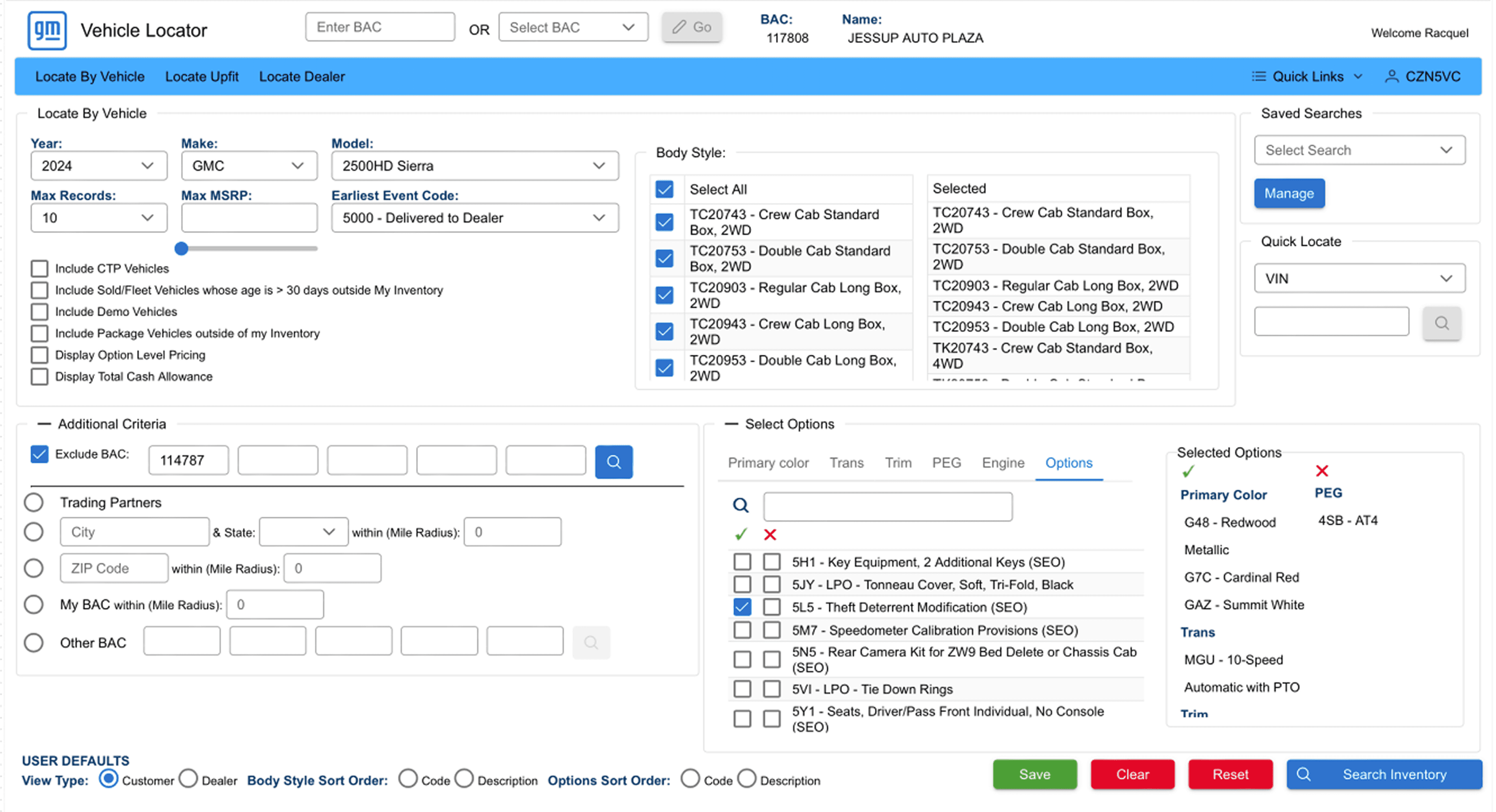
Current-state search: A technical, form-heavy interface that required dealers to memorize specific VIN codes and manual configurations, often leading to 'Zero Result' errors when filters were mismatched.
Research & strategic discovery: Frustration in the field
Research & strategic discovery: Frustration in the field
My field visits to dealerships revealed that the legacy search wasn't just slow, it was a cognitive burden. Dealers were forced to recall complex codes and filters, making what should be a few second search into a complicated task of its own.
My field visits to dealerships revealed that the legacy search wasn't just slow, it was a cognitive burden. Dealers were forced to recall complex codes and filters, making what should be a few second search into a complicated task of its own.
Key findings:
Key findings:
The "impossible search"
Selecting mismatched filters often resulted in zero results, forcing dealers to memorize valid trim/package combinations.
The code barrier
Staff had to memorize technical trim/color codes and Model Year configurations just to perform basic tasks. This often led to them using customer-facing vehicle builders.
Workaround culture
Frustration was so high that dealers attended summits just to trade software workarounds and relied on 3rd-party Chrome extensions to fix GM’s missing logic.
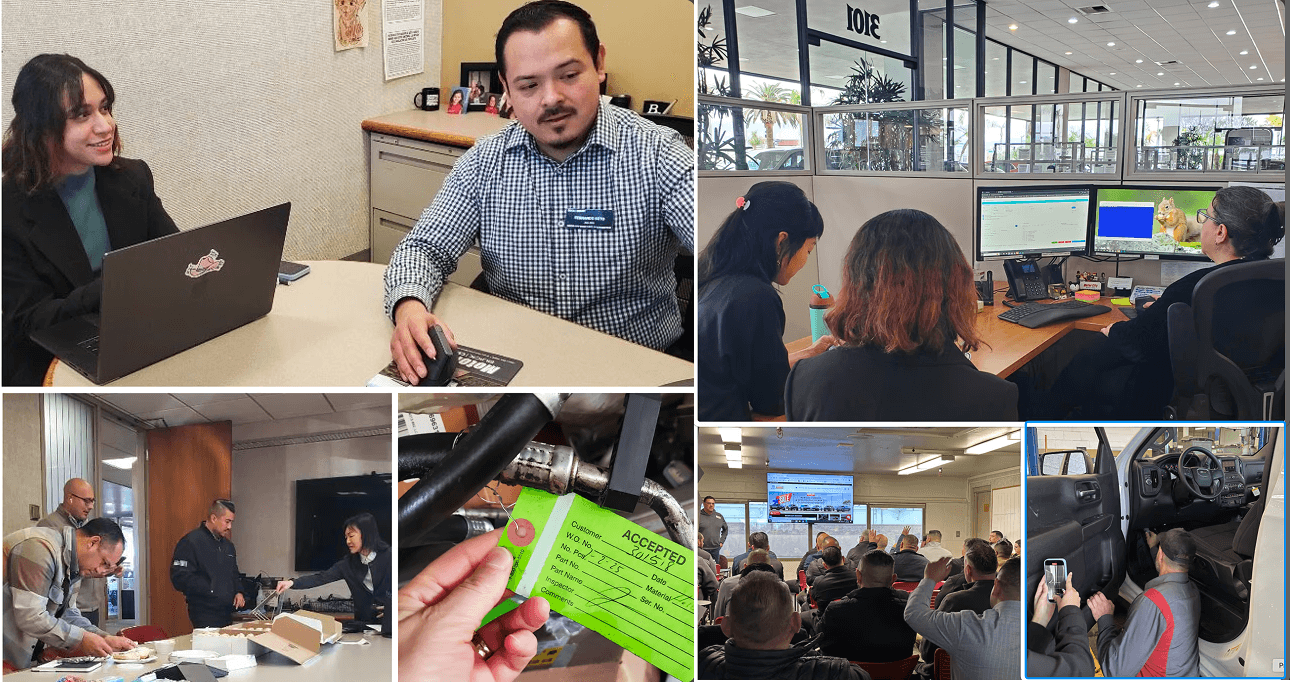
Connecting with sales: Observing and interviewing dealers navigating legacy systems during an on-site visit to identify core workflow bottlenecks.
Design strategy: AI as a guide, not a takeover
Design strategy: AI as a guide, not a takeover
My goal was to move away from a reactive, code-based database and toward natural language search. A system where a dealer’s expertise is augmented, not hindered, by the software. The goal of this project is to reduce the cognitive load of multiple filters and accelerate dealer's sales and search workflow.
My goal was to move away from a reactive, code-based database and toward natural language search. A system where a dealer’s expertise is augmented, not hindered, by the software. The goal of this project is to reduce the cognitive load of multiple filters and accelerate dealer's sales and search workflow.
North Star
To reduce "Time-to-Vehicle" to near-zero by allowing dealers to speak to their inventory as naturally as they speak to their customers.
Tradeoffs: Search bar vs. Conversational bot
Early in the 0–1 process, I considered using a conversational experience. While it felt "more AI," my competitive benchmarkingand dealer visits suggested that in a high-pressure sales environment, a chat interface was too slow.
The Tradeoff: I sacrificed the "novelty" of a chat interface and "in-your-face" AI for a "Smart Search Bar" that felt seamless and baked into the flow.
The Result: This allowed dealers to keep existing search patterns and view all of their inventory while gaining a smarter search experience using NLP. This also ensured that veteran dealers who know their specific codes could still use them.
Tradeoffs: Search bar vs. Conversational bot
Early in the 0–1 process, I considered using a conversational experience. While it felt "more AI," my competitive benchmarkingand dealer visits suggested that in a high-pressure sales environment, a chat interface was too slow.
The Tradeoff: I sacrificed the "novelty" of a chat interface and "in-your-face" AI for a "Smart Search Bar" that felt seamless and baked into the flow.
The Result: This allowed dealers to keep existing search patterns and view all of their inventory while gaining a smarter search experience using NLP. This also ensured that veteran dealers who know their specific codes could still use them.
Thinking outside the box: With search being both simple but vast, I started with low-fidelity wireframes to iterate quickly on the AI search interface without getting distracted by visual design.
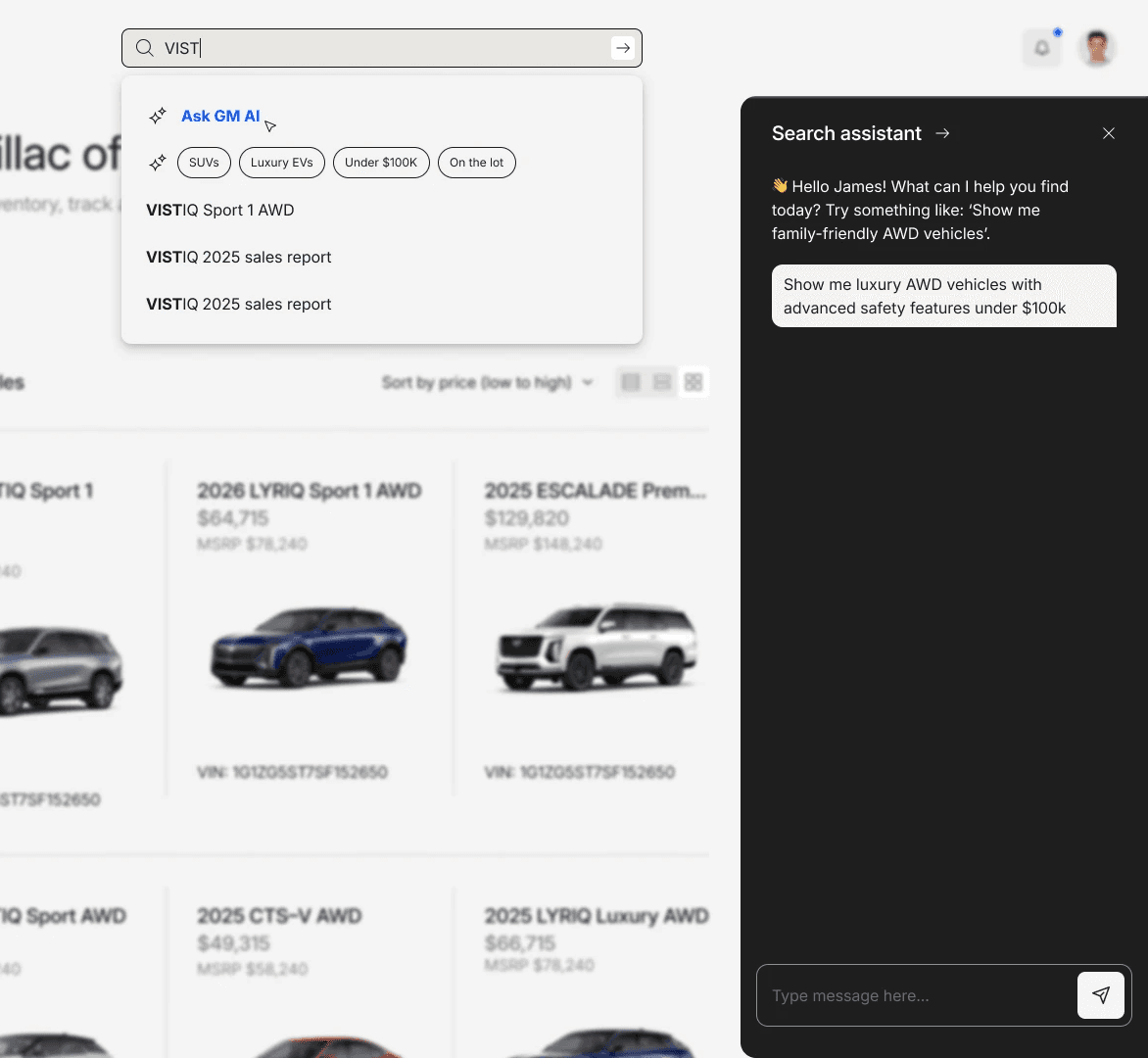
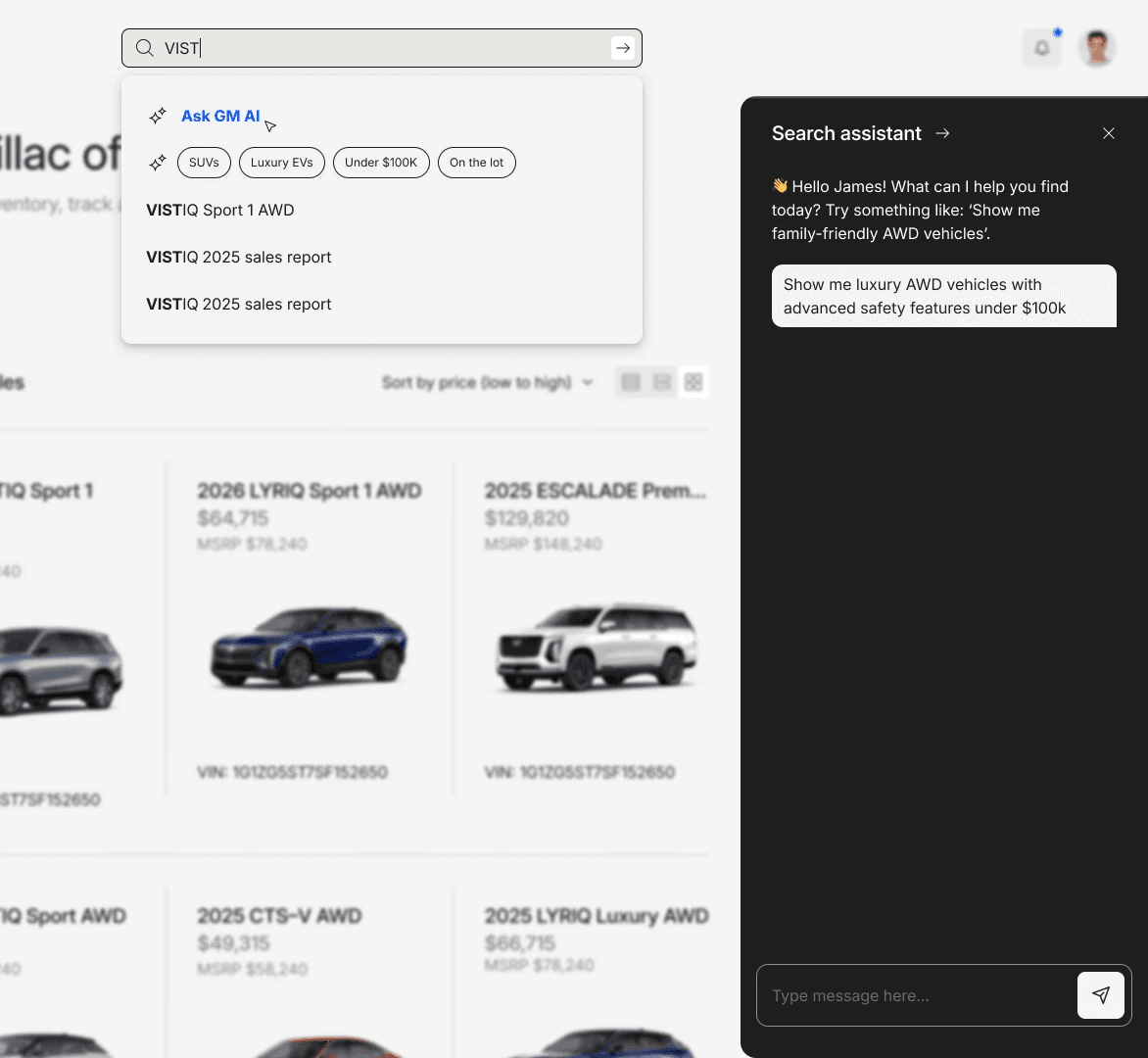
An exploration of agentic UI patterns: While a conversational experience felt 'modern', I opted for an assistive token system to uphold user control, ensuring dealers could audit and override AI suggestions in real-time.
The solution: Intelligent discovery
The solution: Intelligent discovery
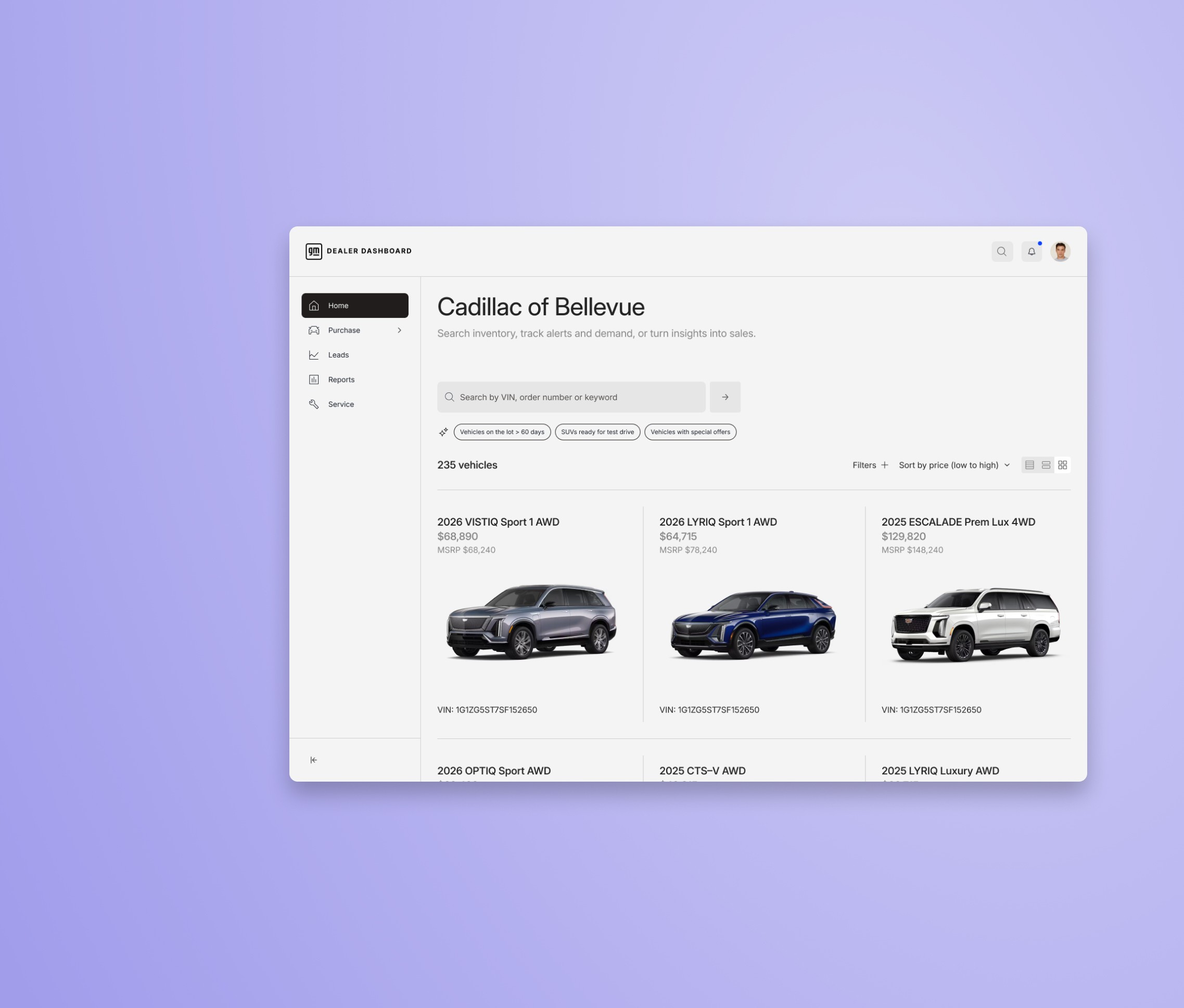
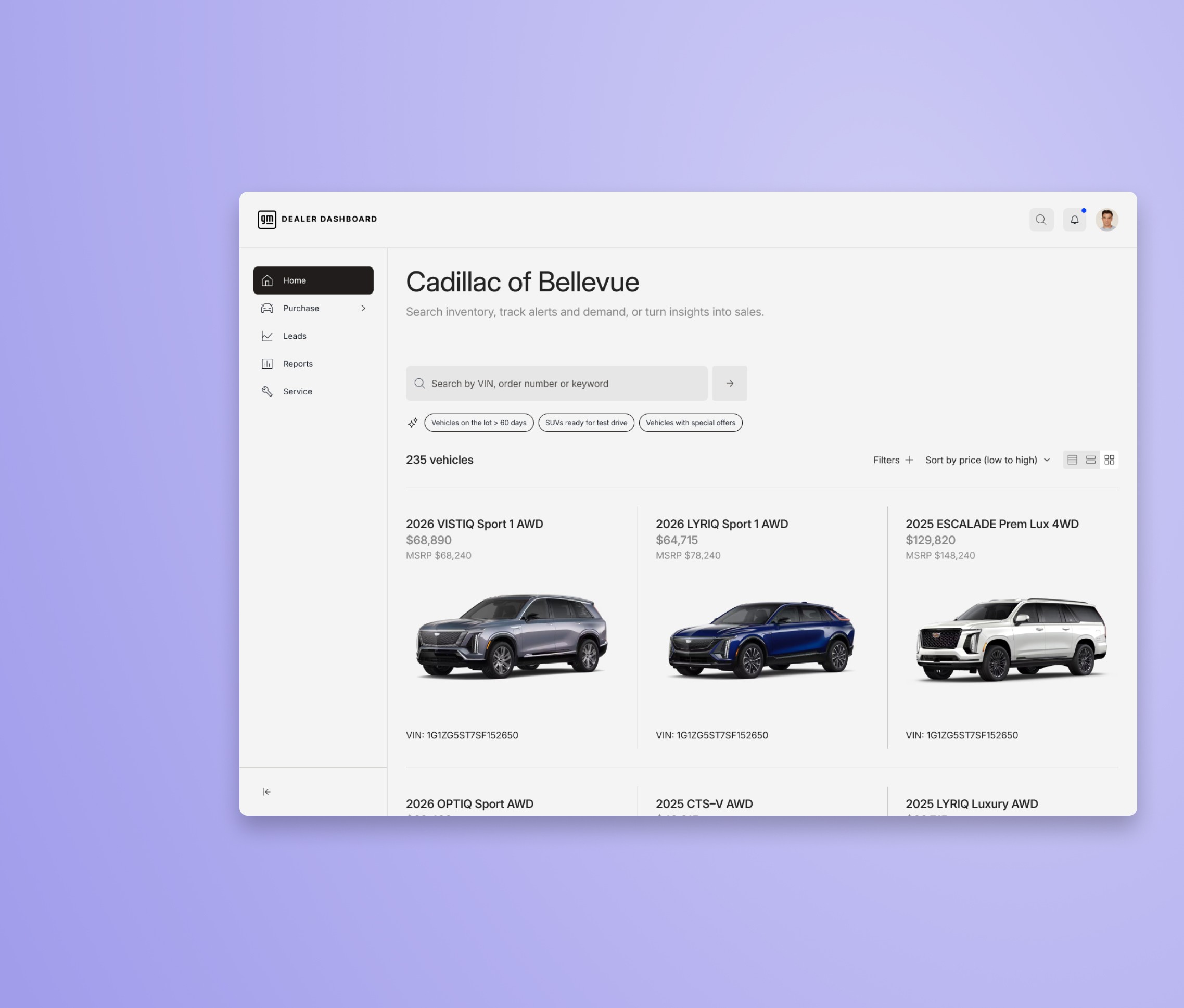
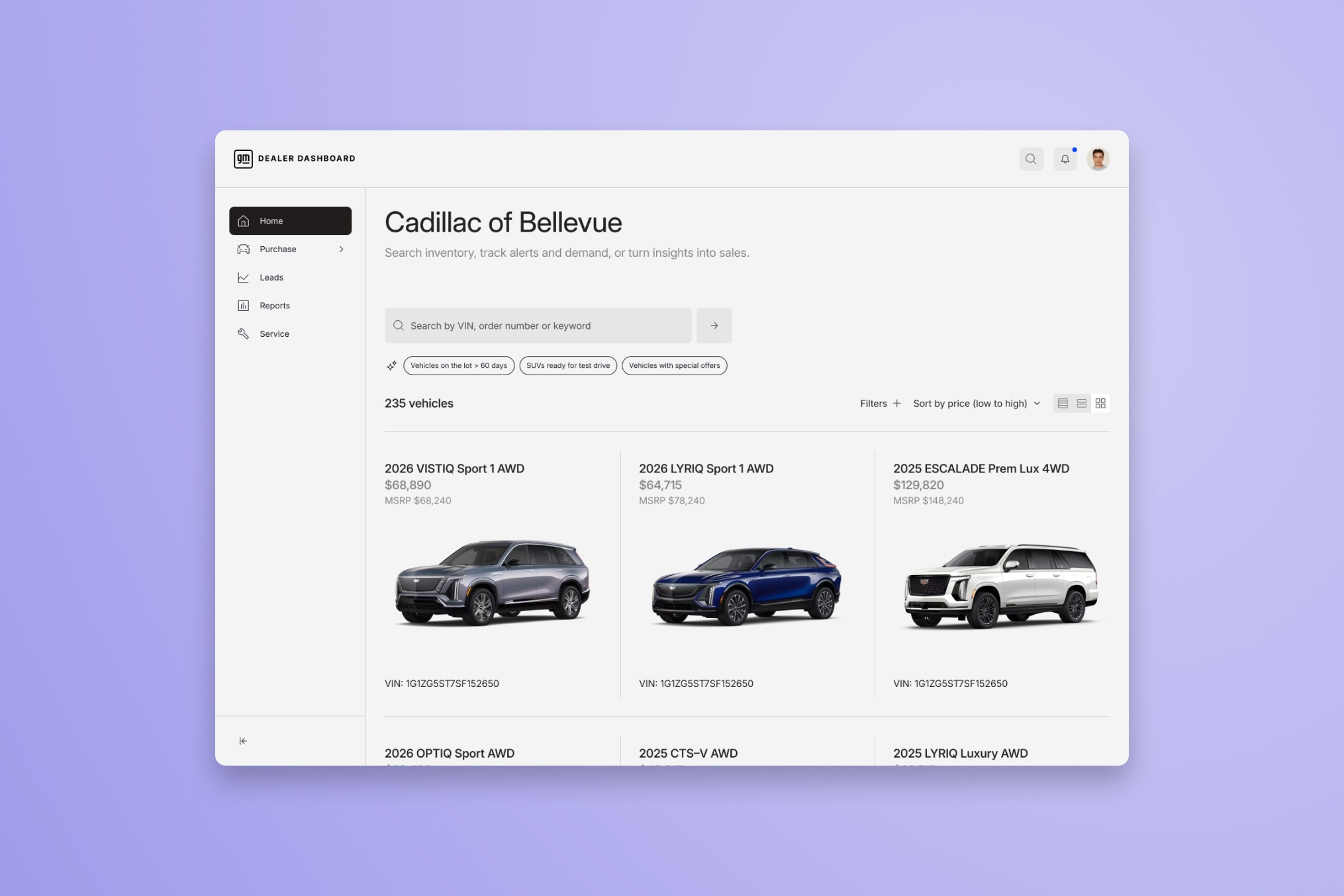
Natural language for inventory discovery Easily query by customer needs (e.g., "Family SUVs under $50k with 3rd row") instead of memorizing technical trim codes. Smart filters time when with a customer to better tailor needs.
Natural language for inventory discovery Easily query by customer needs (e.g., "Family SUVs under $50k with 3rd row") instead of memorizing technical trim codes. Smart filters time when with a customer to better tailor needs.
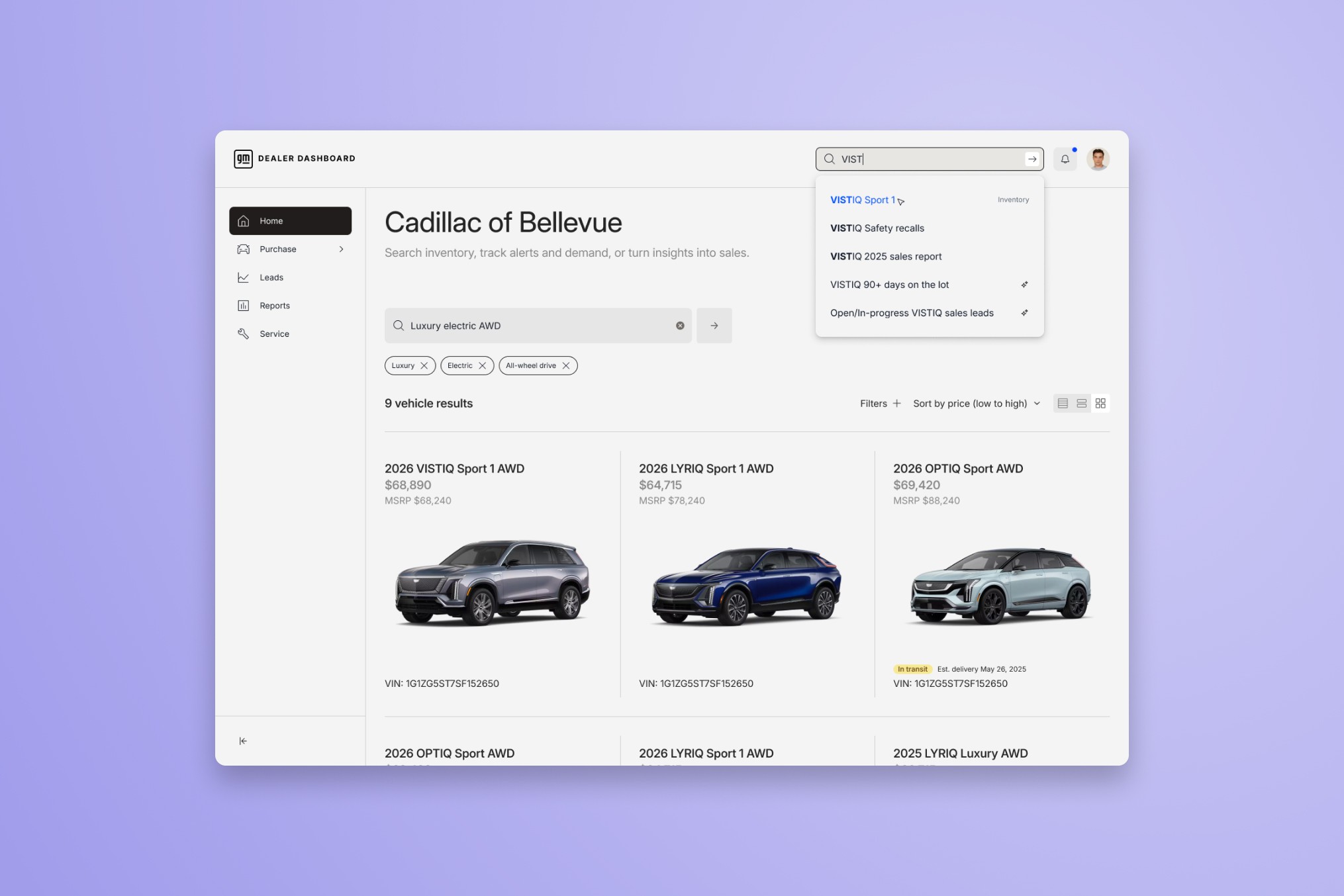
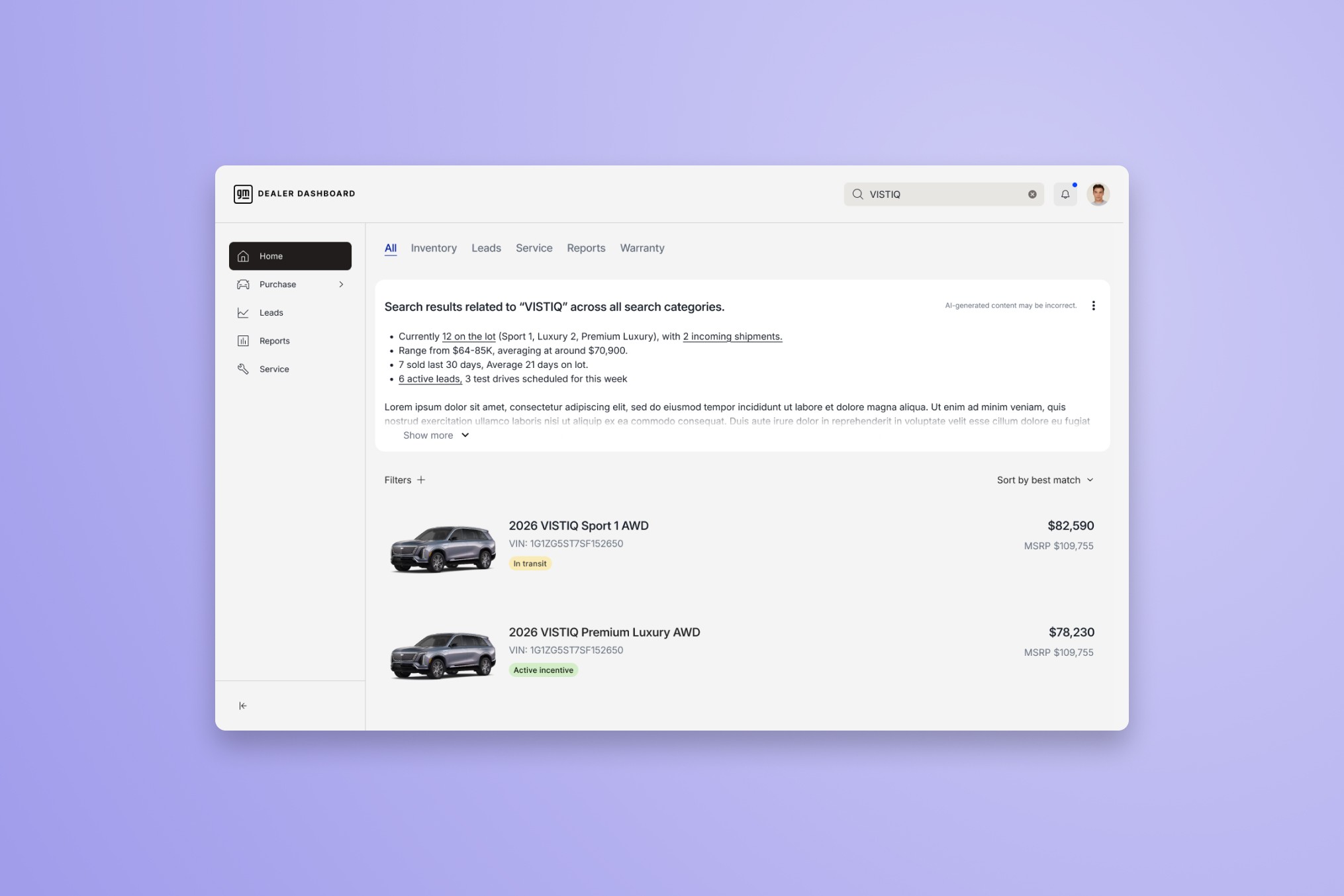
Intelligent global search Search is elastic throughout the application, showing AI suggestions and easy to access vehicle reports and information
Intelligent global search Search is elastic throughout the application, showing AI suggestions and easy to access vehicle reports and information
Validated results summary Global results surface hard data summaries directly from the database. At a glance dealers can quickly see results that span across categories. Summary text explicitly tells the dealer what is available and "on the lot," ensuring they never hit a dead end in front of a customer.
Validated results summary Global results surface hard data summaries directly from the database. At a glance dealers can quickly see results that span across categories. Summary text explicitly tells the dealer what is available and "on the lot," ensuring they never hit a dead end in front of a customer.
Projected impact
Projected impact
75%
Reduced search friction
30%
Search success rate
0
Training on-boarding
15 → 1
Search filters
Based on initial user testing of high-fidelity prototypes and industry benchmarks for AI-enabled automotive sales tools.
Based on initial user testing of high-fidelity prototypes and industry benchmarks for AI-enabled automotive sales tools.
75%
Reduced search friction
30%
Search success rate
0
Training on-boarding
15 → 1
Search filters
Key takeaways
Key takeaways
This project reinforced that impactful UX work is strategic work. It's understanding business constraints, user pain, and technical possibilities, then advocating for solutions that actually solve problems. While large, complex problems can feel insurmountable, the payoff is immense when you show users that someone is finally willing to step up, listen, and take action.
This project reinforced that impactful UX work is strategic work. It's understanding business constraints, user pain, and technical possibilities, then advocating for solutions that actually solve problems. While large, complex problems can feel insurmountable, the payoff is immense when you show users that someone is finally willing to step up, listen, and take action.
AI is an augmentation, not a replacement
The biggest win wasn't adding a shiny new AI feature, but the ability for the feature to stay out of the way. By choosing a Hybrid UI (Smart Bar + Tokens) over a conversational experience, I ensured that the feature did not hinder existing sales flow patterns.
Research matters at all stages
By pointing back to research insights and keeping up with AI research at all points of design, I made sure that at each stage of design was taking account for the way our dealers worked in the field day by day.
AI is an augmentation, not a replacement
The biggest win wasn't adding a shiny new AI feature, but the ability for the feature to stay out of the way. By choosing a Hybrid UI (Smart Bar + Tokens) over a conversational experience, I ensured that the feature did not hinder existing sales flow patterns.
Research matters at all stages
By pointing back to research insights and keeping up with AI research at all points of design, I made sure that at each stage of design was taking account for the way our dealers worked in the field day by day.
AI is an augmentation, not a replacement
The biggest win wasn't adding a shiny new AI feature, but the ability for the feature to stay out of the way. By choosing a Hybrid UI (Smart Bar + Tokens) over a conversational experience, I ensured that the feature did not hinder existing sales flow patterns.
Research matters at all stages
By pointing back to research insights and keeping up with AI research at all points of design, I made sure that at each stage of design was taking account for the way our dealers worked in the field day by day.