Contract Management for General Motors
Unifying 18 touch points into one platform
Problem
How might we eliminate manual workflows managing 85,000+ dealer agreements across 18 broken systems?
Solution
Led a 18-to-1 system consolidation, automating 93% of workflows and 50% reduced turnaround
Role
Lead Product Designer (end-to-end)
Team
Agile pod: Product, Engineering, Legal
18
Apps consolidated
4K
Dealers managed
85k
Active agreements
50%
Reduced cycles
The challenge: Pushing back against doing a quick re-skin for a legacy app
Legal contracts between GM and dealerships are required when a dealer wants to submit a legal change (i.e buy/sell a dealership, add an investor, etc.), corporate contract managers use several legacy apps and spreadsheets to execute high-stakes legal changes for a 4,000+ dealer network.
One of these legacy third-party applications needed to be replaced within the end of the year, and stakeholders/IT wanted a fast UI reskin to migrate the application before the deadline.
Upon doing discovery and research I realized these users had far larger problems than just an expiring UI.
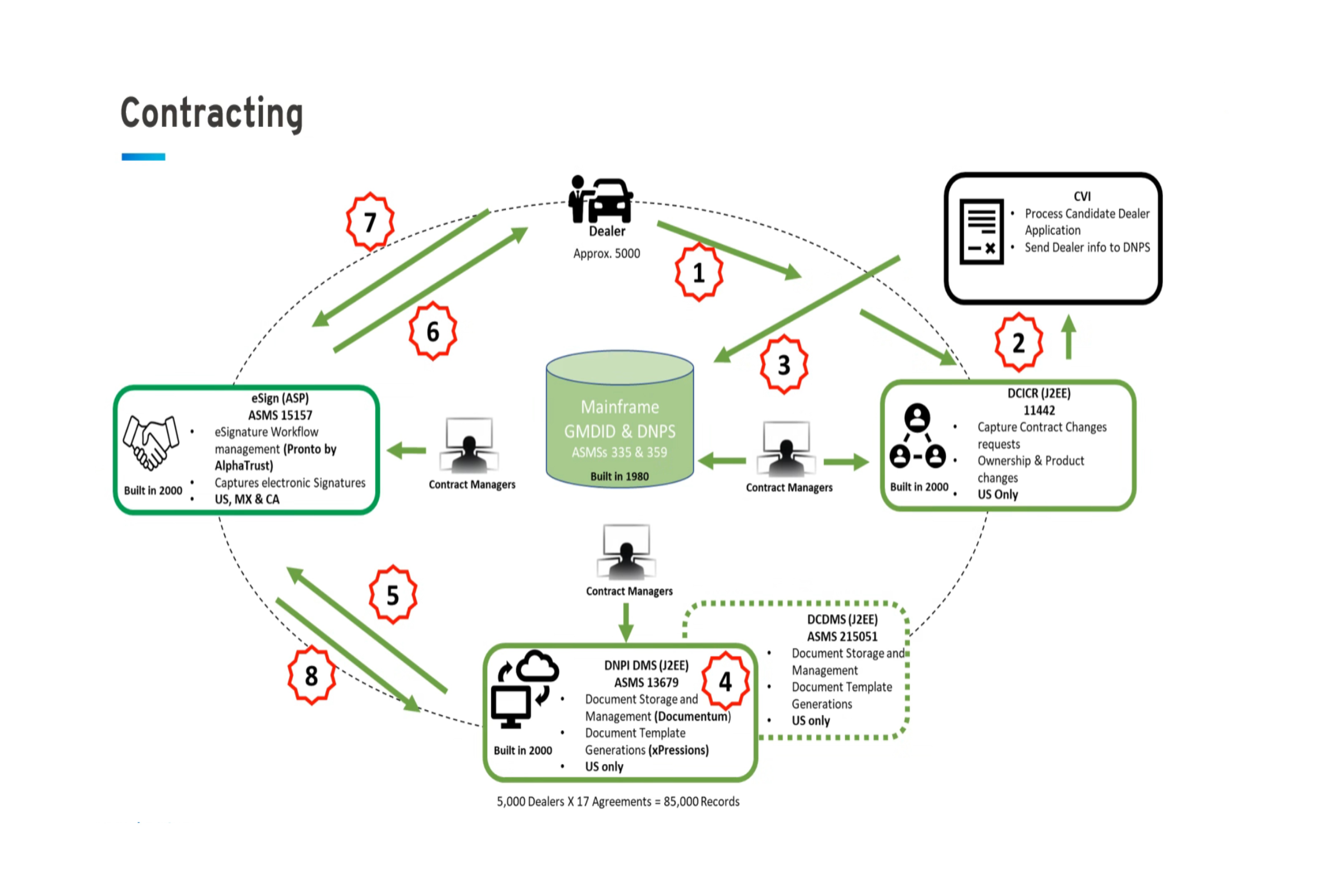
IT data diagram: Contract Managers were the glue for the entire workflow, manually syncing data across legacy systems built between 1980-2000, and managing 85,000 active records
Research & discovery: Identifying the high cost of fragmentation
To better understand these complex legal workflows, I traveled across GM offices and led field research, shadowed workflows, mapped every touchpoint, and analzyed the "shadow systems" in Excel and Outlook. In tandem, I led design sprints and workshops to further validate and organize these findings.
Key findings:
Fragmented systems
Built in 2000, systems were old and outdated and required several work-arounds to track important information.
The "Human API"
Contract Managers manually synced data across 18 touch points like Excel, Outlook and legacy mainframe databases.
Legal liability
State-mandated deadlines were tracked in spreadsheets. Missed deadlines could cause serious legal ramifications.

Driving team alignment: Facilitating a cross-functional workshop to validate the "18-to-1" system consolidation. By involving stakeholders early in the mapping process, we identified technical constraints and gained buy-in for a phased automation approach.
Design strategy: Engineering a single source of truth
With a hard deadline to replace an expiring system, my strategy was focused on systemic consolidation while keeping legal integrity. I engineered a single-app workspace where Contract Managers could execute every stage of a proposal without ever leaving the application.
North Star
Enable faster, simpler contracting through a single source of truth, without increasing cognitive load or risking legal compliance.
Tradeoffs: Efficient iteration over pixel-perfection
To ensure a robust launch under tight time and resource constraints, I shifted the delivery strategy toward a standardized framework for MVP.
The Logic: By creating templatized workflows and components (tables, modals, widgets) I made it so that I could focus on complex legal and edge-case scenarios that the system may need to account for.
High-Fidelity Validation: I presented stakeholders and end users with hi-fi wireframes to show realistic view of the data density and to gain rapid feedback and iteration in order to keep consistent with the complex legal and technical details of the various contracting processes.
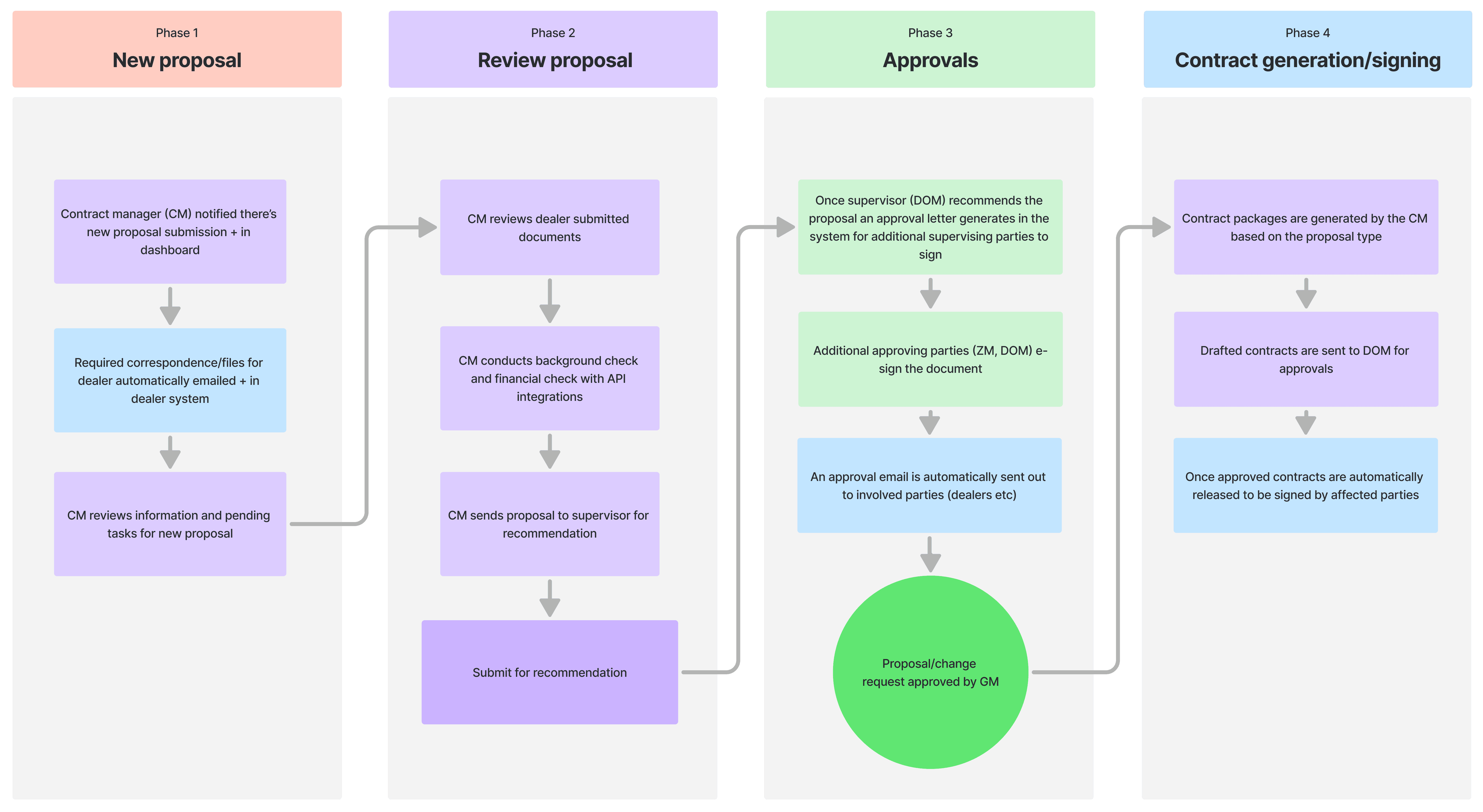
The 18-to-1 Blueprint: This finalized architecture represents the successful consolidation of 18 manual touchpoints into one automated ecosystem. By integrating background checks and document generation directly into the flow, we replaced "shadow spreadsheets" with a 93% automated contract lifecycle.
The solution: All-in-one contract dashboard
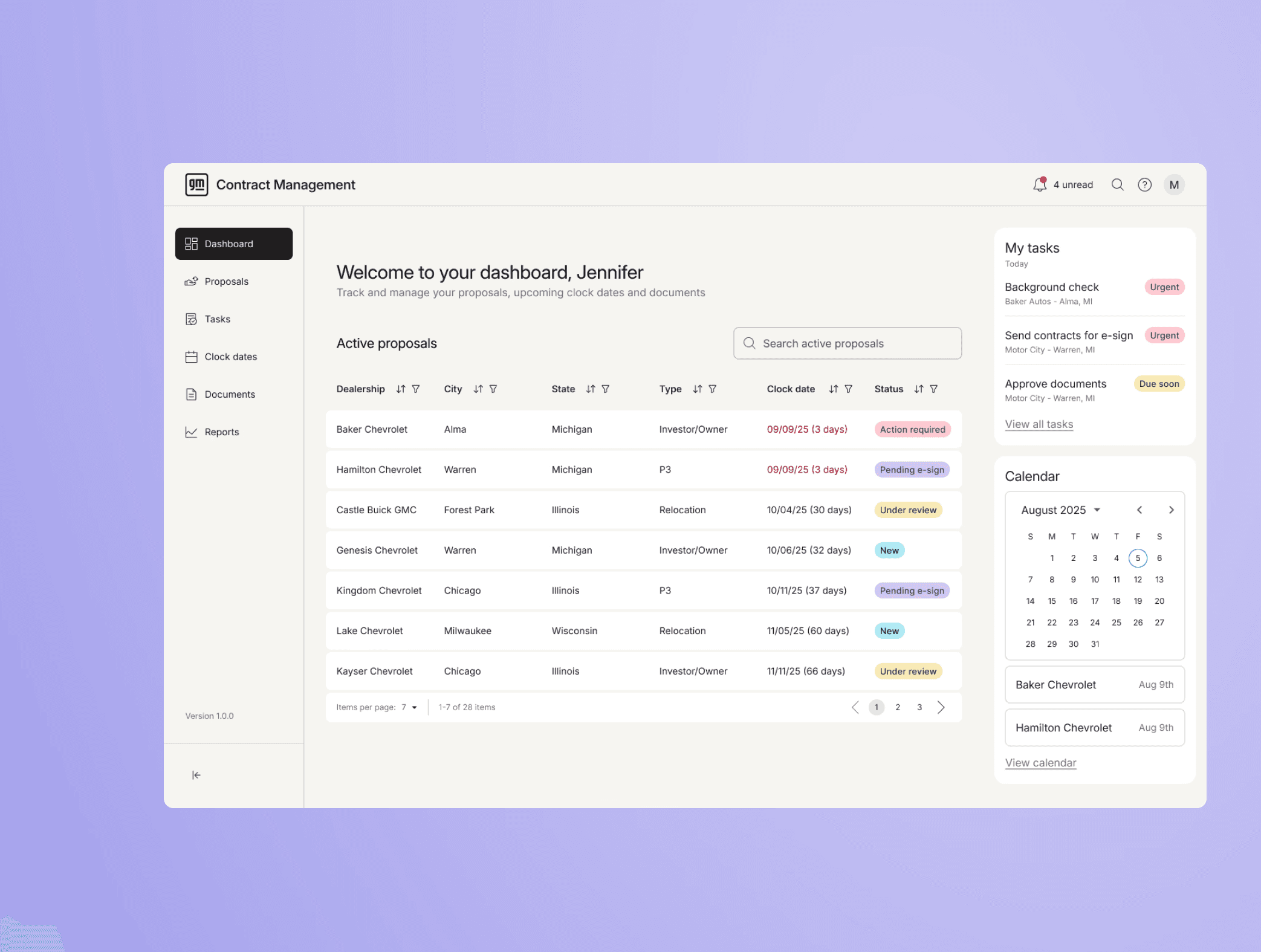
Unified dashboard
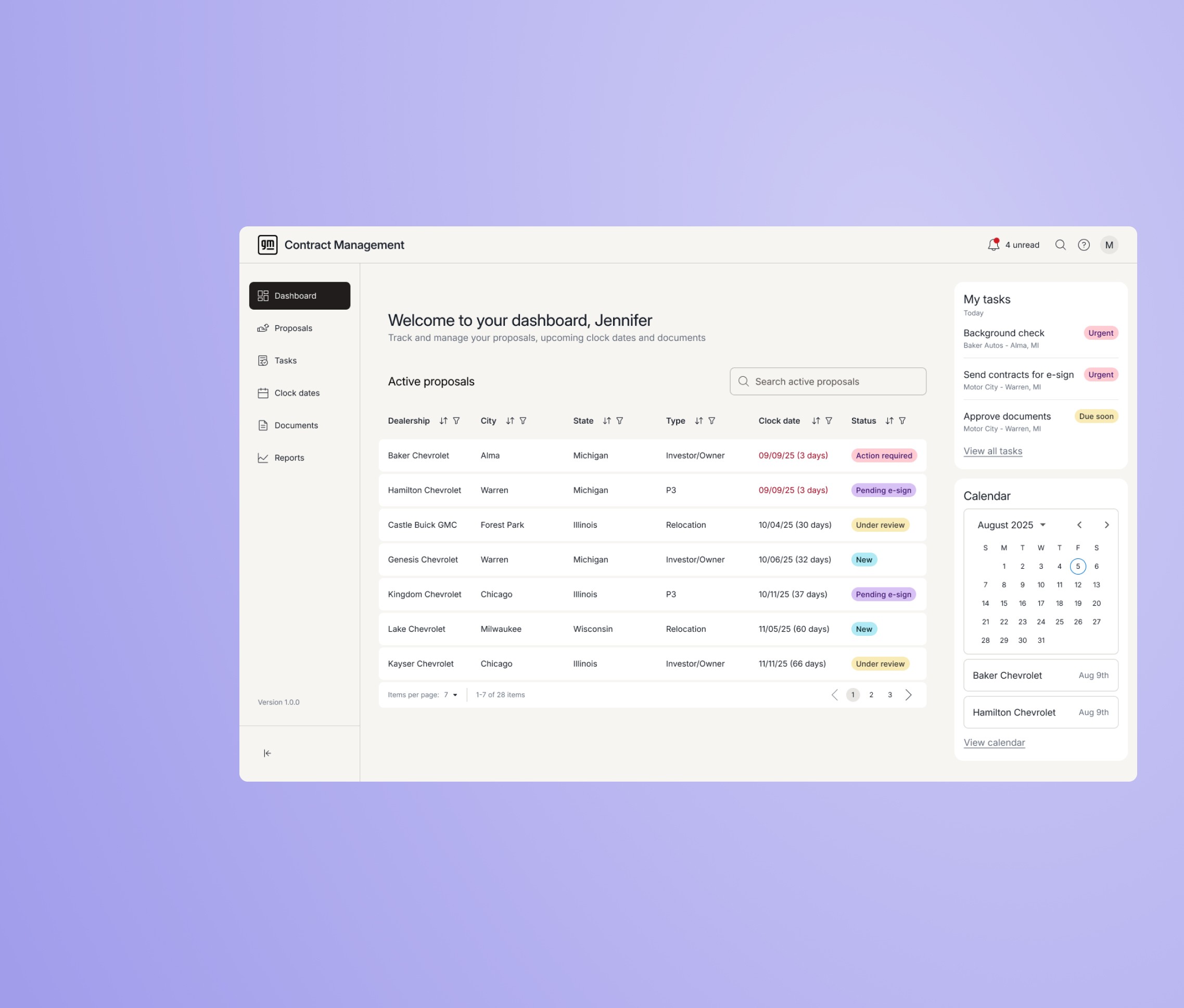
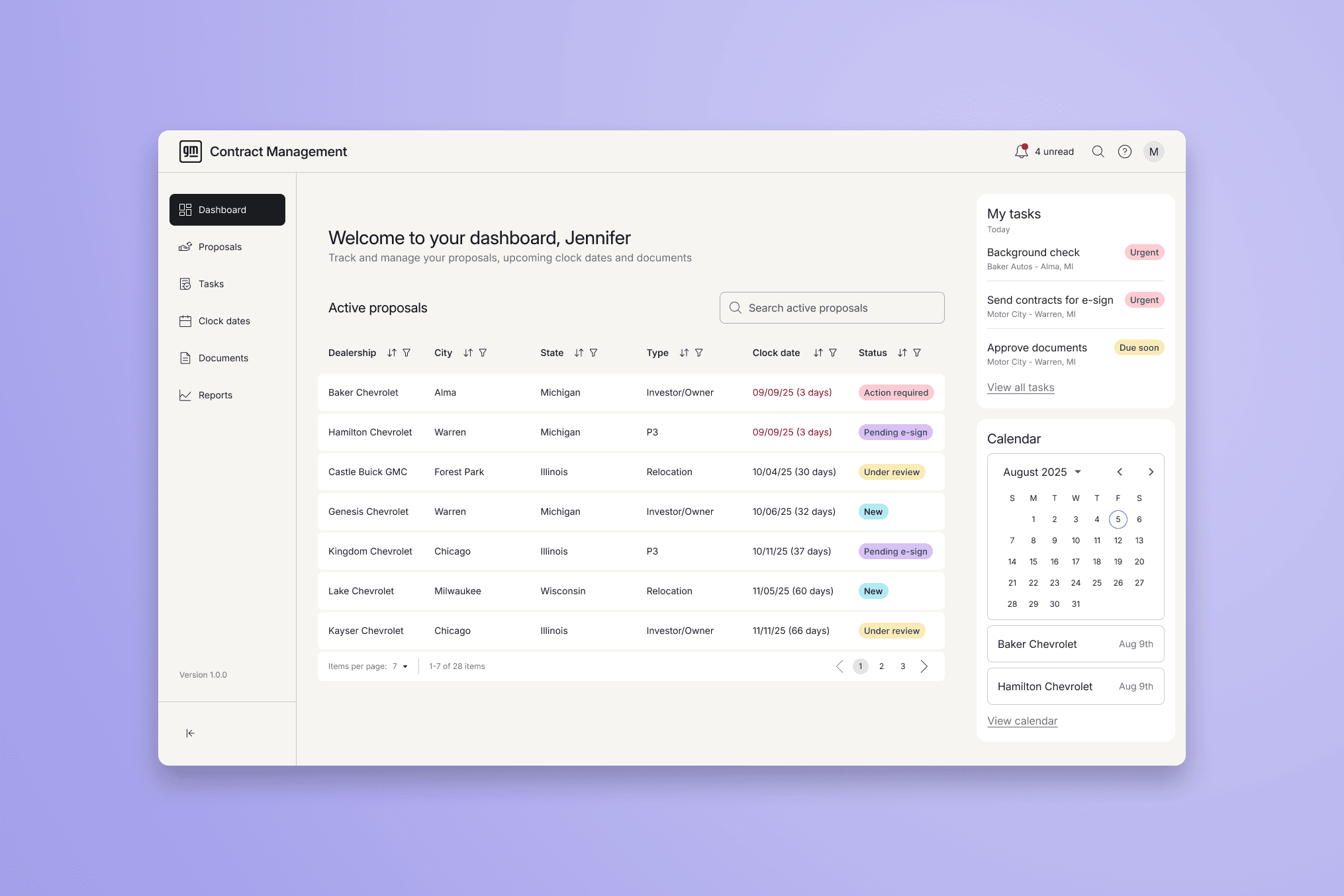
Single view of all active proposals with real-time status and widgets. System calculates state-specific legal windows and sends proactive notifications. Replaced personal spreadsheet tracking.
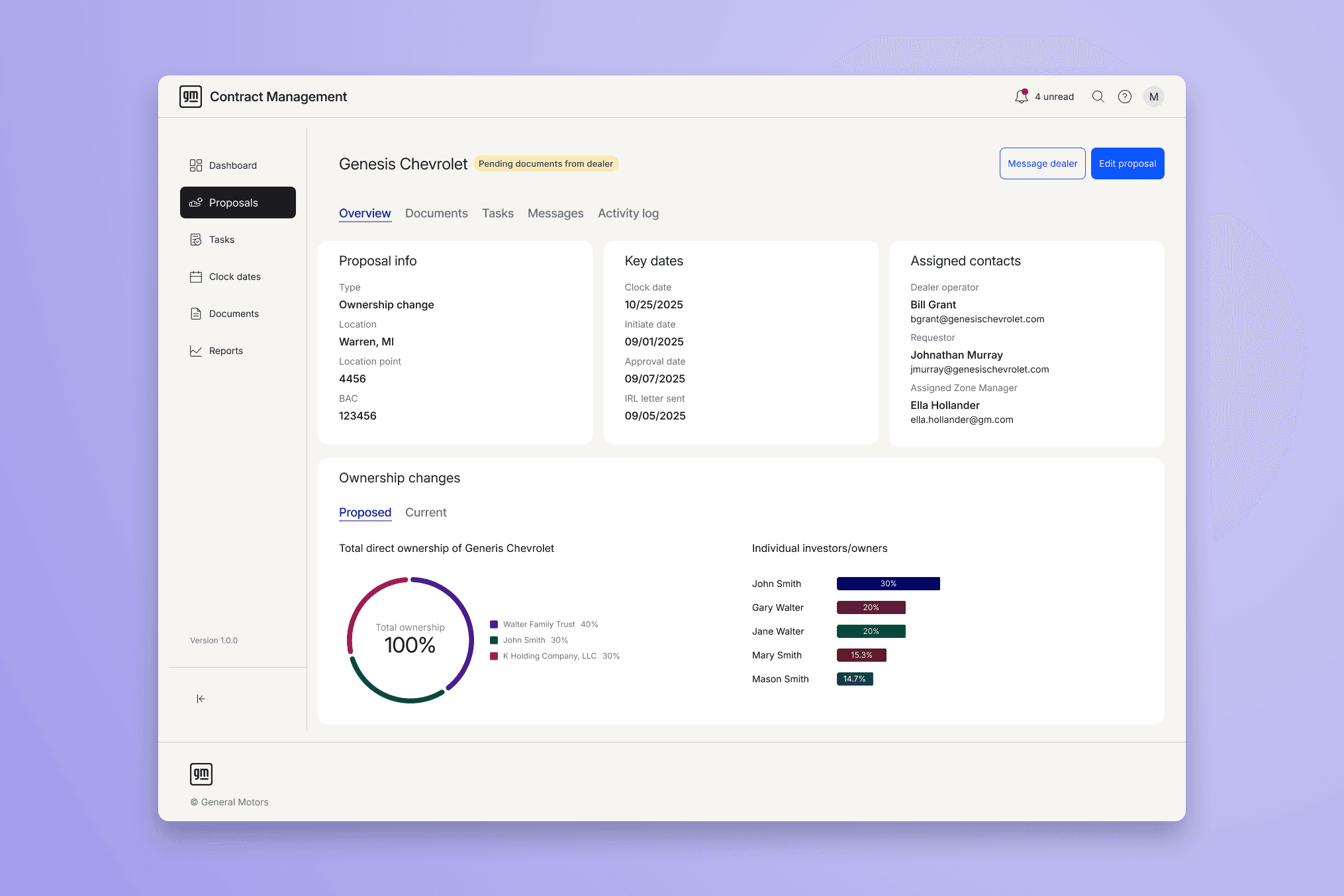
Visible content and status
Proposals now feature a centralized hub for all core information, including dealer submissions, pending tasks, and message history.
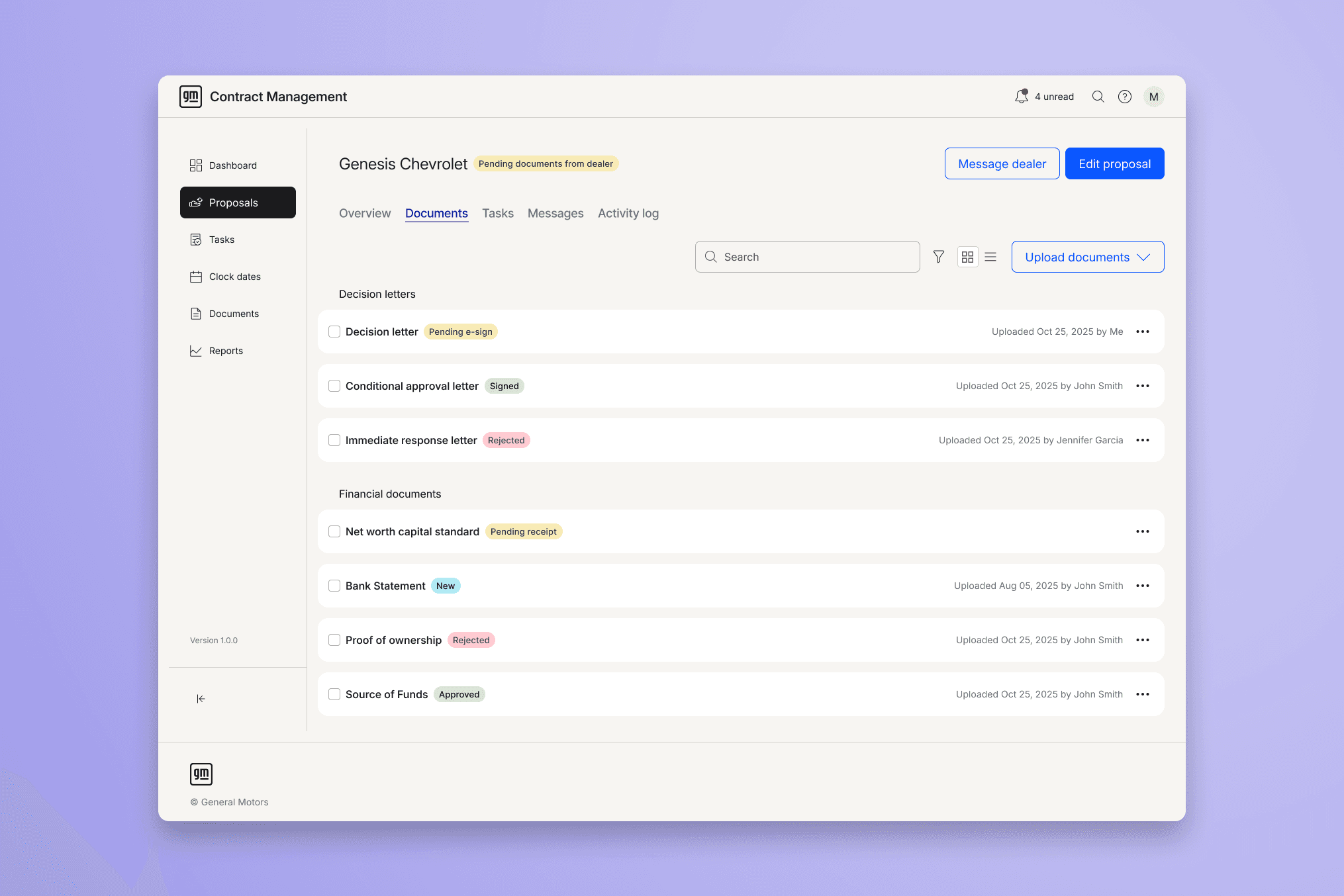
Centralized document management
All files, approvals, and contract generation in one location with built-in commenting, audit trails, and e-signature integration.
The impact: From crisis to strategic asset
4 → 2
Months avg contract turnaround time
93%
Workflows automated in one system
85k
Dealer contracts migrated
18 → 1
Touch points consolidated
Qualitative impact: Contract managers shifted from copy-paste data corrections to high-value proposal review. Dealers gained self-service capabilities and real-time visibility and communication. Legal compliance risk dropped significantly through automated deadline tracking and audit trails.
Key takeaways
This project reinforced that impactful UX work is strategic work. It's understanding business constraints, user pain, and technical possibilities, then advocating for solutions that actually solve problems. While large, complex problems can feel insurmountable, the payoff is immense when you show users that someone is finally willing to step up, listen, and take action.
Challenge the brief when it matters
Stakeholders don't always know what they need. Research-backed pushback got buy-in for meaningful change over superficial fixes.
Design systems, not just screens
The core problem was fragmented information architecture. Understanding the full ecosystem enabled system-level improvement.
Tight feedback loops prevent costly mistakes
Weekly validation with stakeholders, developers, and end users kept iteration focused on real problems, not assumptions.
Strategic design transcends implementation
Even when development shifted to Adobe Experience Manager, the UX strategy shaped business requirements and demonstrated lasting value.
Contract Management for General Motors
Unifying 18 touch points into one platform
Role
Lead Product Designer (end-to-end)
Team
Agile pod: Product, Engineering, Legal
Problem
How might we unify fragmented workflows to ensure compliance and rebuild user trust?
Solution
Led a 18-to-1 system consolidation, automating 93% of workflows and 50% reduced turnaround
18
Apps consolidated
4K
Dealers managed
93%
Manual reduction
50%
Reduced cycles
The challenge: when a 'quick reskin' requires a strategic intervention
Legal contracts between GM and dealerships are required when a dealer wants to submit a legal change (i.e buy/sell a dealership, add an investor, etc.), corporate contract managers use several legacy apps and spreadsheets to execute high-stakes legal changes for a 4,000+ dealer network.
One of these legacy third-party applications needed to be replaced within the end of the year, and stakeholders/IT wanted a fast UI reskin to migrate the application before the deadline.
Upon doing discovery and research I realized these users had far larger problems than just an expiring UI.
Research & strategic discovery: Identifying the high cost of fragmentation
To better understand these complex legal workflows, I traveled across GM offices and led field research, shadowed workflows, mapped every touchpoint, and analzyed the "shadow systems" in Excel and Outlook. In tandem, I led design sprints and workshops to further validate and organize these findings.
Key findings:
Fragmented systems
Built in 2000, systems were old and outdated and required several work-arounds to track important information.
The "Human API"
Contract Managers manually synced data across 18 touch points like Excel, Outlook and legacy mainframe databases.
Legal liability
State-mandated deadlines were tracked in spreadsheets. Missed deadlines could cause serious legal ramifications.
IT data diagram: Contract Managers were the glue for the entire workflow, manually syncing data across legacy systems built between 1980-2000, and managing 85,000 active records
Driving Team Alignment: Facilitating a cross-functional workshop to validate the "18-to-1" system consolidation. By involving stakeholders early in the mapping process, we identified technical constraints and gained buy-in for a phased automation approach.
Design strategy: Engineering a single source of truth
With a hard deadline to replace an expiring system, my strategy was focused on systemic consolidation while keeping legal integrity. I engineered a single-app workspace where Contract Managers could execute every stage of a proposal without ever leaving the application.
North Star
Enable faster, simpler contracting through a single source of truth, without increasing cognitive load or risking legal compliance.
Tradeoffs: Efficient iteration over pixel-perfection
To ensure a robust launch under tight time and resource constraints, I shifted the delivery strategy toward a standardized framework for MVP.
The Logic: By creating templatized workflows and components (tables, modals, widgets) I made it so that I could focus on complex legal and edge-case scenarios that the system may need to account for.
High-Fidelity Validation: I presented stakeholders and end users with hi-fi wireframes to show realistic view of the data density and to gain rapid feedback and iteration in order to keep consistent with the complex legal and technical details of the various contracting processes.
The 18-to-1 Blueprint: This finalized architecture represents the successful consolidation of 18 manual touchpoints into one automated ecosystem. By integrating background checks and document generation directly into the flow, we replaced "shadow spreadsheets" with a 93% automated contract lifecycle.
The solution: All-in-one contract dashboard
Unified dashboard
Single view of all active proposals with real-time status and widgets. System calculates state-specific legal windows and sends proactive notifications. Replaced personal spreadsheet tracking.
Visible content and status
Proposals now feature a centralized hub for all core information, including dealer submissions, pending tasks, and message history.
Centralized document management
All files, approvals, and contract generation in one location with built-in commenting, audit trails, and e-signature integration.
The impact: From crisis to strategic asset
4 → 2
Months avg contract turnaround time
93%
Workflows automated in one system
85k
Dealer contracts migrated
18 → 1
Touch points consolidated
Qualitative impact: Contract managers shifted from copy-paste data corrections to high-value proposal review. Dealers gained self-service capabilities and real-time visibility and communication. Legal compliance risk dropped significantly through automated deadline tracking and audit trails.
Key takeaways
This project reinforced that impactful UX work is strategic work. It's understanding business constraints, user pain, and technical possibilities, then advocating for solutions that actually solve problems. While large, complex problems can feel insurmountable, the payoff is immense when you show users that someone is finally willing to step up, listen, and take action.
Challenge the brief when it matters
Stakeholders don't always know what they need. Research-backed pushback got buy-in for meaningful change over superficial fixes.
Design systems, not just screens
The core problem was fragmented information architecture. Understanding the full ecosystem enabled system-level improvement.
Tight feedback loops prevent costly mistakes
Weekly validation with stakeholders, developers, and end users kept iteration focused on real problems, not assumptions.
Strategic design transcends implementation
Even when development shifted to Adobe Experience Manager, the UX strategy shaped business requirements and demonstrated lasting value.
Contract Management for General Motors
Unifying 18 touch points into one platform
Role
Lead Product Designer (end-to-end)
Team
Agile pod: Product, Engineering, Legal
Problem
How might we unify fragmented workflows to ensure compliance and rebuild user trust?
Solution
Led a 18-to-1 system consolidation, automating 93% of workflows and 50% reduced turnaround
18
Apps consolidated
4K
Dealers managed
93%
Manual reduction
50%
Reduced cycles
The challenge: when a 'quick reskin' requires a strategic intervention
Legal contracts between GM and dealerships are required when a dealer wants to submit a legal change (i.e buy/sell a dealership, add an investor, etc.), corporate contract managers use several legacy apps and spreadsheets to execute high-stakes legal changes for a 4,000+ dealer network.
One of these legacy third-party applications needed to be replaced within the end of the year, and stakeholders/IT wanted a fast UI reskin to migrate the application before the deadline.
Upon doing discovery and research I realized these users had far larger problems than just an expiring UI.
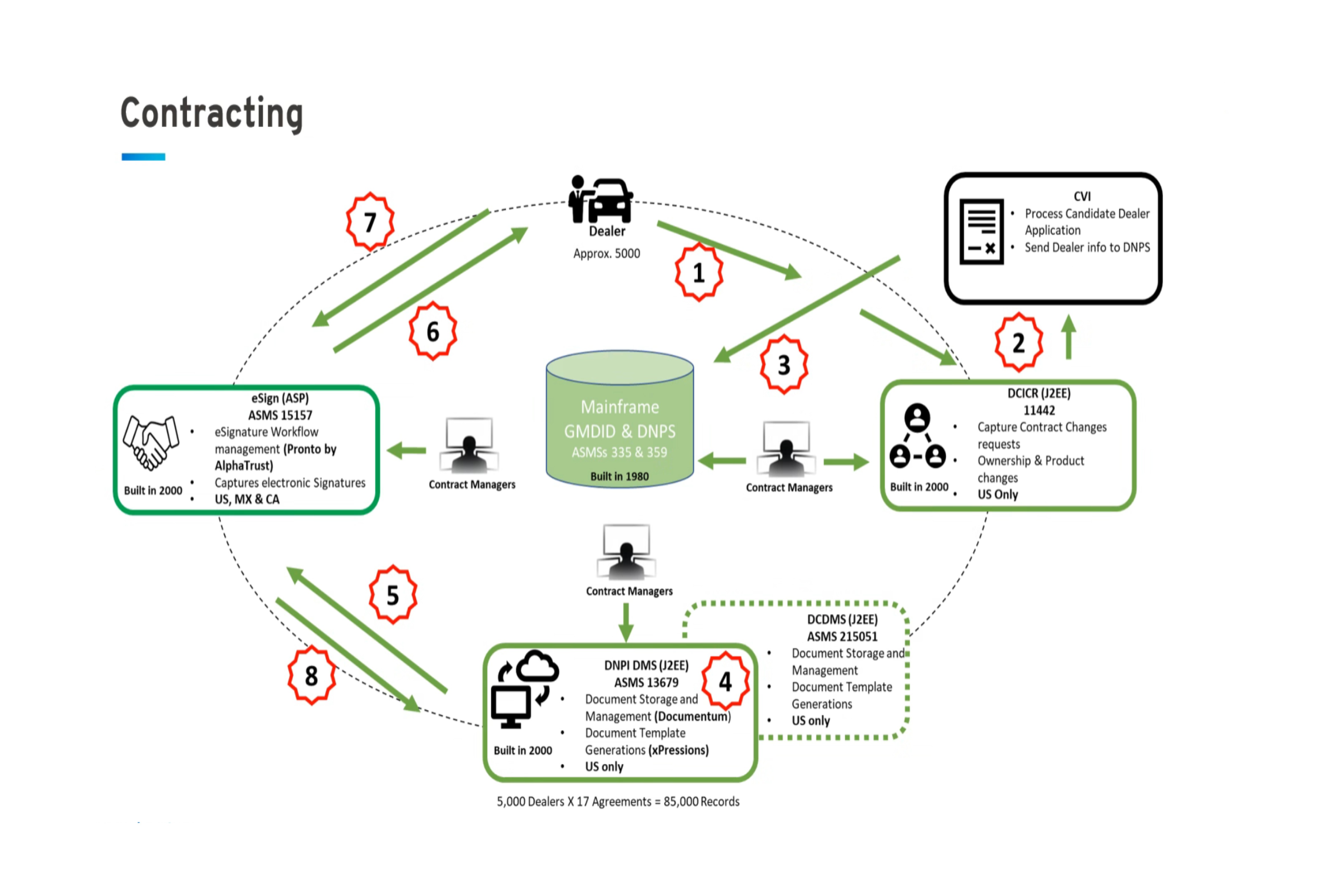
IT data diagram: Contract Managers were the glue for the entire workflow, manually syncing data across legacy systems built between 1980-2000, and managing 85,000 active records
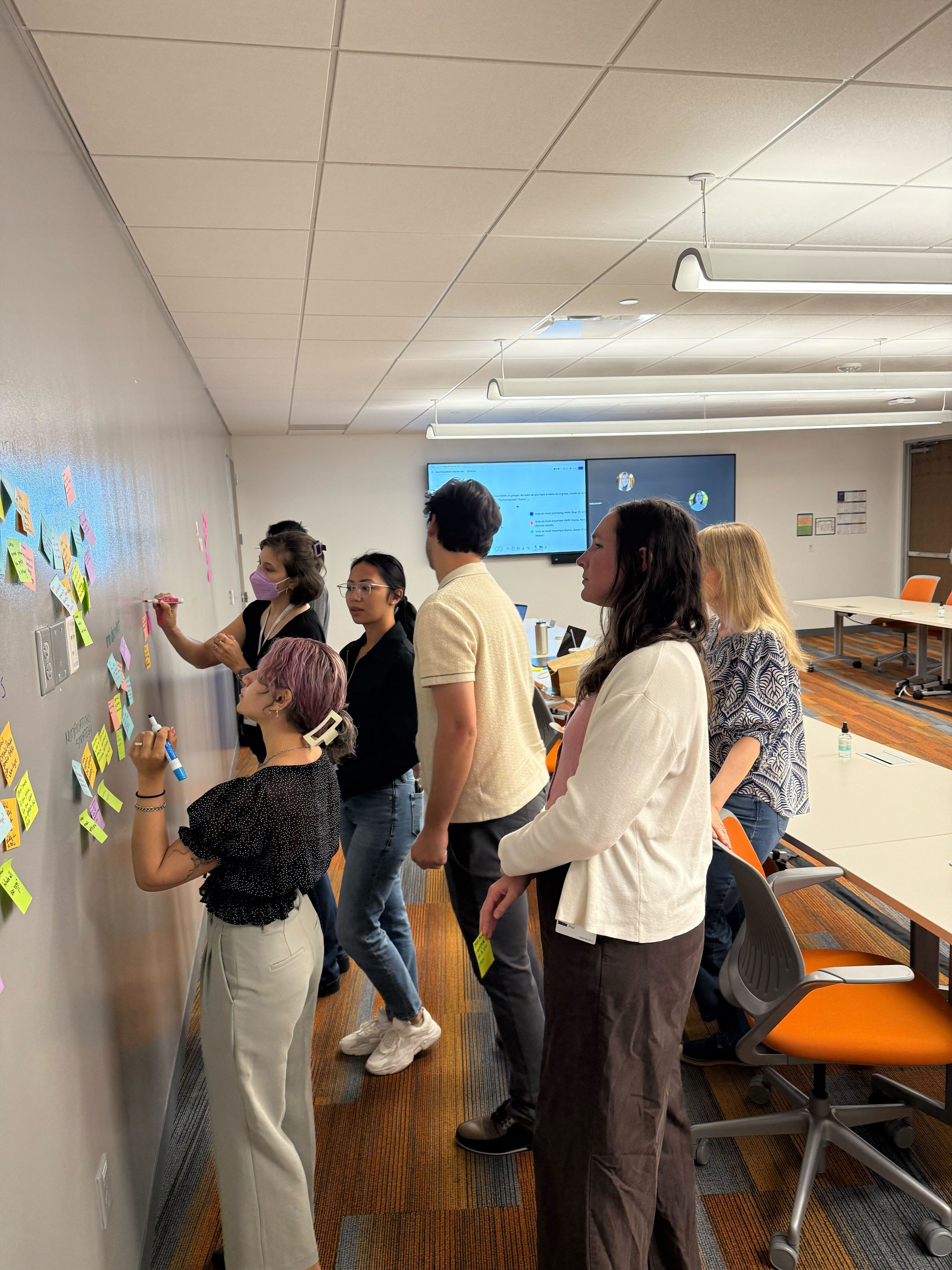
Driving Team Alignment: Facilitating a cross-functional workshop to validate the "18-to-1" system consolidation. By involving stakeholders early in the mapping process, we identified technical constraints and gained buy-in for a phased automation approach.
Research & strategic discovery: Identifying the high cost of fragmentation
To better understand these complex legal workflows, I traveled across GM offices and led field research, shadowed workflows, mapped every touchpoint, and analzyed the "shadow systems" in Excel and Outlook. In tandem, I led design sprints and workshops to further validate and organize these findings.
Key findings:
Fragmented systems
Built in 2000, systems were old and outdated and required several work-arounds to track important information.
The "Human API"
Contract Managers manually synced data across 18 touch points like Excel, Outlook and legacy mainframe databases.
Legal liability
State-mandated deadlines were tracked in spreadsheets. Missed deadlines could cause serious legal ramifications.
Design strategy: Engineering a single source of truth
With a hard deadline to replace an expiring system, my strategy was focused on systemic consolidation while keeping legal integrity. I engineered a single-app workspace where Contract Managers could execute every stage of a proposal without ever leaving the application.
North Star
Enable faster, simpler contracting through a single source of truth, without increasing cognitive load or risking legal compliance.
Tradeoffs: Efficient iteration over pixel-perfection
To ensure a robust launch under tight time and resource constraints, I shifted the delivery strategy toward a standardized framework for MVP.
The Logic: By creating templatized workflows and components (tables, modals, widgets) I made it so that I could focus on complex legal and edge-case scenarios that the system may need to account for.
High-Fidelity Validation: I presented stakeholders and end users with hi-fi wireframes to show realistic view of the data density and to gain rapid feedback and iteration in order to keep consistent with the complex legal and technical details of the various contracting processes.
The 18-to-1 Blueprint: This finalized architecture represents the successful consolidation of 18 manual touchpoints into one automated ecosystem. By integrating background checks and document generation directly into the flow, we replaced "shadow spreadsheets" with a 93% automated contract lifecycle.
The solution: All-in-one contract dashboard
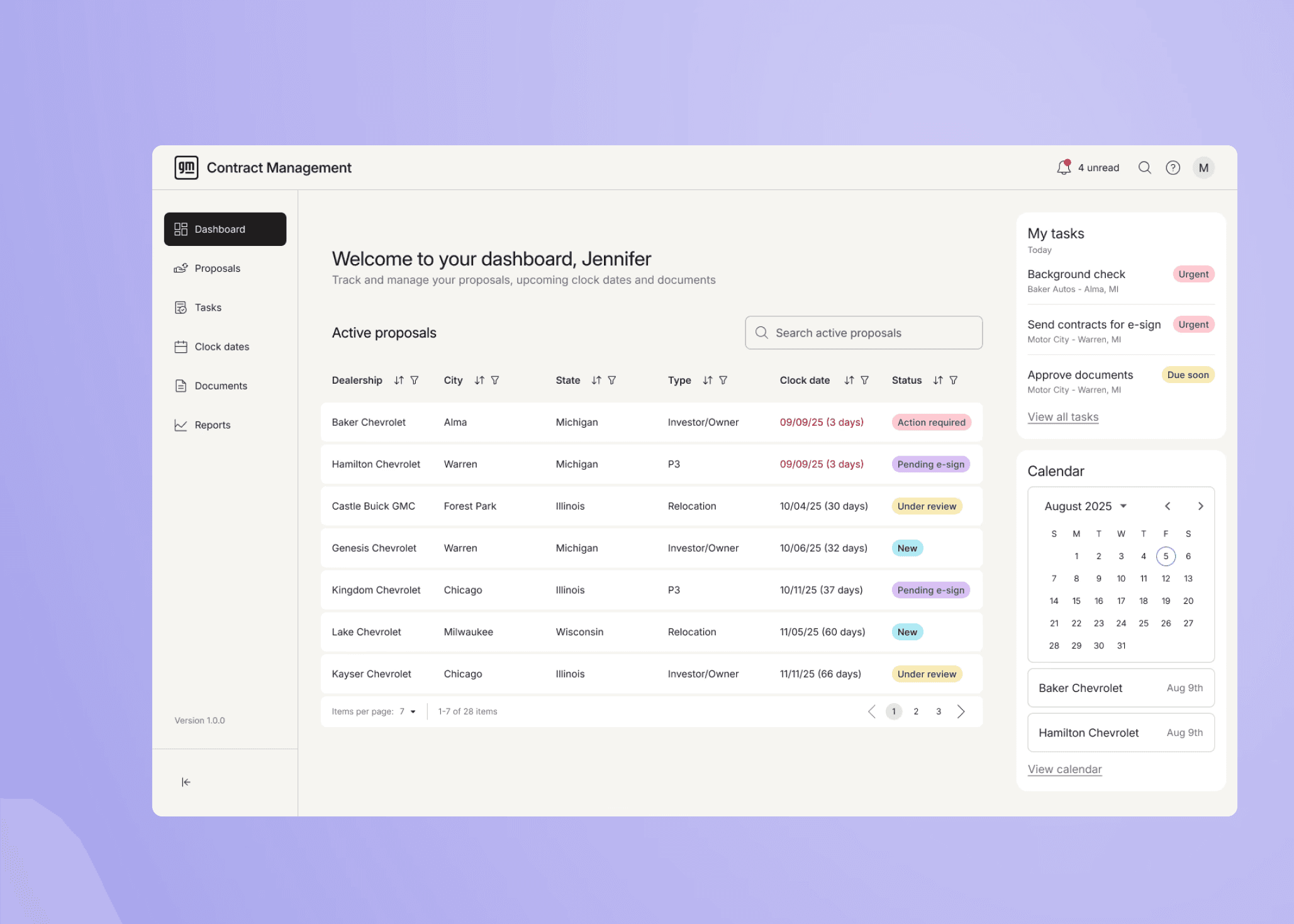
Unified dashboard
Single view of all active proposals with real-time status and widgets. System calculates state-specific legal windows and sends proactive notifications. Replaced personal spreadsheet tracking.
Visible content and status
Proposals now feature a centralized hub for all core information, including dealer submissions, pending tasks, and message history.
Centralized document management
All files, approvals, and contract generation in one location with built-in commenting, audit trails, and e-signature integration.
The impact: From crisis to strategic asset
4 → 2
Months avg contract turnaround time
93%
Workflows automated in one system
85k
Dealer contracts migrated
18 → 1
Touch points consolidated
Qualitative impact: Contract managers shifted from copy-paste data corrections to high-value proposal review. Dealers gained self-service capabilities and real-time visibility and communication. Legal compliance risk dropped significantly through automated deadline tracking and audit trails.
Key takeaways
This project reinforced that impactful UX work is strategic work. It's understanding business constraints, user pain, and technical possibilities, then advocating for solutions that actually solve problems. While large, complex problems can feel insurmountable, the payoff is immense when you show users that someone is finally willing to step up, listen, and take action.
Challenge the brief when it matters
Stakeholders don't always know what they need. Research-backed pushback got buy-in for meaningful change over superficial fixes.
Tight feedback loops prevent costly mistakes
Weekly validation with stakeholders, developers, and end users kept iteration focused on real problems, not assumptions.
Design systems, not just screens
The core problem was fragmented information architecture. Understanding the full ecosystem enabled system-level improvement.
Strategic design transcends implementation
Even when development shifted to Adobe Experience Manager, the UX strategy shaped business requirements and demonstrated lasting value.